10 must-visit Art Nouveau houses and mansions in Brussels
29 October 2026

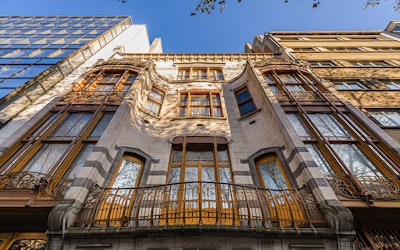
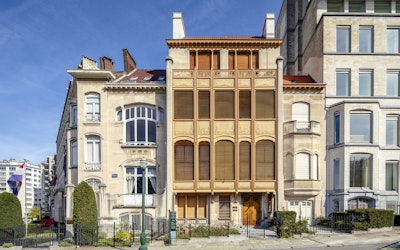
Victor Horta, maison Tassel huis © Maxime Delvaux
At the end of the 19th century, Victor Horta broke with the dominant, traditional architectural styles in Brussels, giving birth to the iconic Art Nouveau genre. Along the streets of our capital, numerous houses and mansions bear witness to the emergence and blossoming of this unprecedented style.
Horta, Hankar, Van de Velde and other great names in Brussels architecture drew their inspiration from the organic forms of nature, sometimes with a touch of Japanese inspiration. The capital’s appearance was transformed, and its facades were brought to life in magnificent fashion. To make sure you don’t miss a thing, we’ve put together a top 10 of Brussels’ unmissable Art Nouveau houses and mansions!
1. Solvay House
A UNESCO World Heritage Sites since 2000, Solvay House is regarded as one of Victor Horta’s finest works. It was commissioned by industrialist Armand Solvay, son of Ernest, who gave Horta an almost illimited budget to complete the masterpiece. Standing on the illustrious avenue Louise, this luxurious townhouse on a 15-metre-wide plot is a perfect example of how the well-to-do families of 19th century bourgeoisie lived.
Avenue Louise 224, 1050 Ixelles
Booking required.
2. Hannon House
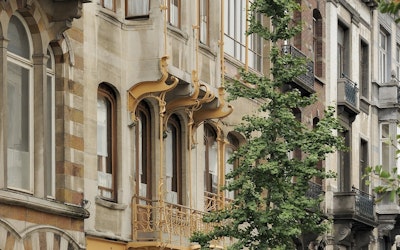
Closed for several years for restoration works, this little Art Nouveau gem will reopen its doors in 2023. Designed by architect Jules Brunfaut, it has been restored to its former splendour, thanks in particular to original pieces of furniture by Émile Gallé, a leading figure of the École de Nancy. The spiral staircase at the heart of Hannon House draws the eye, as does Les joies de la vie, the mythologically inspired fresco that adorns its walls. Aesthetes and artists, Édouard and Marie Hannon breathed life and soul into their ‘portrait house’. Upstairs, temporary exhibitions showcase the riches of Art Nouveau and its many influences.
Avenue de la Jonction 1, 1060 Saint-Gilles
Booking recommended; booking required with a Pass or for a guided tour.

© visit.brussels
3. Cauchie House
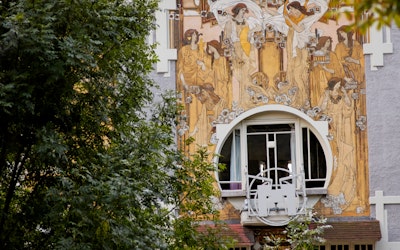
Built in 1905, Cauchie House, was named after architect and original owner Paul Cauchie. Aside from its superb round window, the building's facade features several large sgraffiti, which make the building stand out and are evidence of Cauchie and his wife Caroline “Lina” Voet’s decorative talent.
Rue des Francs 5, 1040 Etterbeek
Booking required.

© visit.brussels
4. Autrique House
Autrique House, designed by Victor Horta in 1893, is the first large town house that the great architect built, in 1893, almost at the same time as he designed Tassel House. Here too the structural and decorative innovations that are so characteristic of Art Nouveau are on show.
Chaussée de Haecht 266, 1030 Schaerbeek
Booking required.

© Marie-Françoise Plissart
5. The Horta Museum
The Horta Museum is housed in two connected buildings: The architect’s house and his workshop. They are the perfect examples of the peak of Art Nouveau. Both buildings were bought by the commune of Saint-Gilles in the 60s, with the home restored and turned into a museum which opened in 1969. The workshop was bought in 1971 and incorporated into the museum in 1973.
Rue Américaine 27, 1060 Saint-Gilles
Booking recommended.
6. Max Hallet House
Buit in 1903 by Victor Horta, Max Hallet House, on the prestigious avenue Louise, is characterised by its sober facade. This simplicity isn’t just down to the logical evolution of Art Nouveau architecture around 1900, it’s also because of the building’s original purpose, which was to be both the home and office of lawyer Max Hallet.
Avenue Louise 346, 1050 Ixelles
One-off visits, booking required.

© sophie voituron
7. The Belgian Comic Strip Center
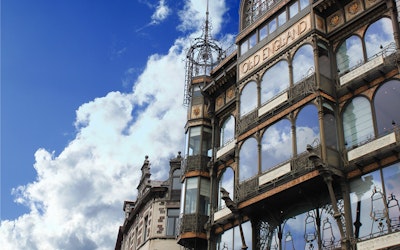
The Belgian Comic Strip Center, a former textiles warehouse, was designed by Victor Horta for textile merchant Charles Waucquez. Listed in 1975, then bought by the government in the 1980s to save it from being demolished, it now houses a centre dedicated to Belgian comic strips. You can visit its magnificent entrance hall free of charge.
Rue des Sables 20, 1000 City of Brussels
Visit the museum without booking or by appointment.

© CBBD / BSC
8. Foundation Frison Horta
Built in 1894 by Horta, in the heart of the capital, Frison House was commissioned by renowned lawyer Georges Frison. Both a professional practice and a living space, it blends nature and light down to the very last detail, with murals and other playful nods to nature present on every floor. Now it is the home and workspace of the Frison Horta Foundation, an arts centre devoted to promoting exchanges between Indian and European cultural traditions.
Rue Lebeau 37, 1000 City of Brussels
Guided tours by appointment.

© Foundation Frison Horta
9. Van Eetvelde House & LAB
Victor Horta himself considered van Eetvelde House to be his most daring design. Commissioned by the future Baron Edmond van Eetvelde, this mansion is renowned for the luxury of its interiors: a study furnished in African mahogany, a drawing room panelled in green onyx and gilded bronze, and a dining room adorned with embossed tapestry and stained-glass windows made from American glass… The highlight of the property is undoubtedly the glass roof of its winter garden, supported by 32 ribs and 8 metal pillars. The mansion forms part of a complex built in three phases. Since 2023, the building that once housed Edmond van Eetvelde’s former study has been home to the LAB·AN, an exhibition venue dedicated to Brussels Art Nouveau and its history.
Avenue Palmerston 2-4, 1000 City of Brussels
Booking required.

© Hôtel van Eetvelde
10. Tassel House
Regarded as the seminal work of Art Nouveau, Tassel House was declared a UNESCO World Heritage Site in 2000. With its audacious bow-window and remarkable light wells, this building left a lasting mark on the history of architecture.
Rue Paul-Émile Janson 6, 1050 Ixelles
Rare visits take place during BANAD festival.

© Sophie Voituron
Top Tip!
The Art Nouveau Pass lets you discover Brussels’ Art Nouveau gems at an unbeatable price. Choose 3 sites from a list of 9 emblematic constructions, like Cauchie House, the Horta Museum, Autrique House and even Solvay House (depending on the pass chosen).
The pass is valid 9 months, to the great delight of all architecture fans!